Developing a vision for AI enabled care coordination
Our Head of Product tasked me and a co-design lead with envisioning what AI-enabled care coordination at Cityblock could look like three years out. Her challenge: Be bold. If teammates recognized our current platform in the vision, we hadn't pushed far enough.
A vision built on cross-functional collaboration
We started with existing evidence, pulling insights from recent research, past design explorations, and AI predictions from our own CEO. Then we ran and a series of cross-functional ideation sessions bringing together clinical leaders, engineers, our CTO, AI consultants, and behavioral researchers. This mix ensured a vision grounded in clinical reality, technical feasibility, and human behavior.
Conveying the vision with words
The final vignettes spanned a variety of scenarios and roles, covering care team, manager and patient experiences, and considered when AI got it right and when AI got it wrong.
Despite her hesitation, our Head of Product found the stories compelling and shared them immediately with other leaders, a strong signal that the format worked: making the vision easy to digest, discuss, and champion. Ahead of a board meeting, we selected one narrative of an AI-enhanced visit-prep to turn into a short film.
Ideas from the vision, are now entering product team H2 roadmaps.
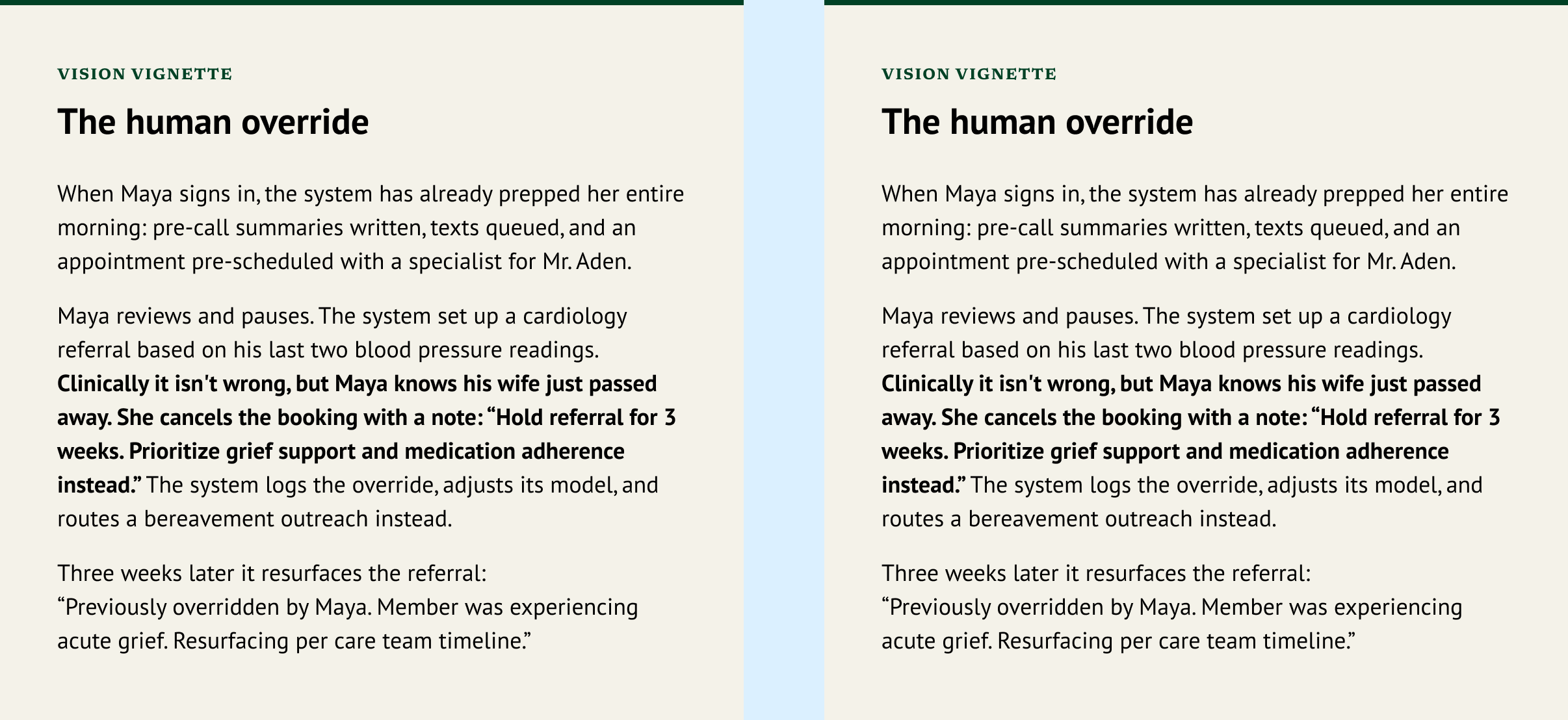
Vision vignettes spanned a variety of scenarios and roles and considered the impact when AI got it right and when AI got it wrong.
After theming the ideas that emerged, I proposed telling them as short narrative vignettes instead of visual mockups. Although the Head of Product was skeptical, I believed vignettes would better allow us to describe UI-less experiences, like background automation and voice interaction, and also help stakeholders consider key concepts and ideas without getting hung up on the details of a screen design. I used Claude to quickly synthesize the inputs into story form.
Bringing the vision to life